
Separators
Puroflux offers a broad spectrum of separators in a range of materials and configurations.
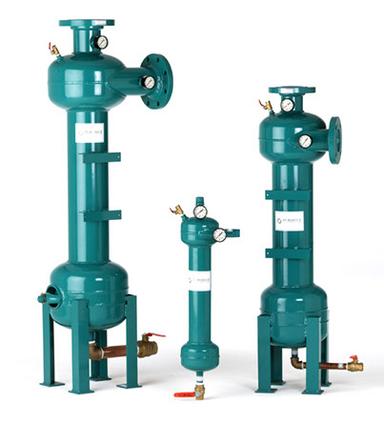
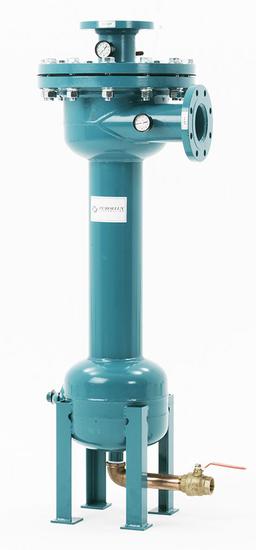
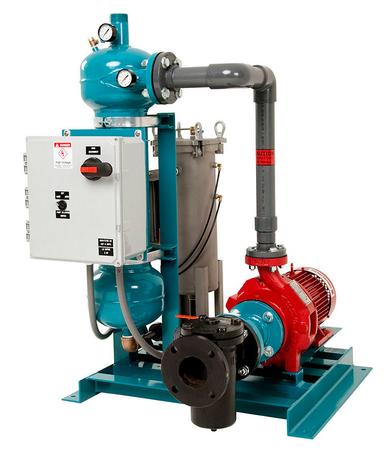
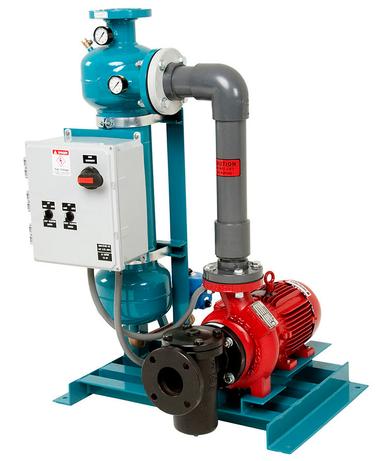
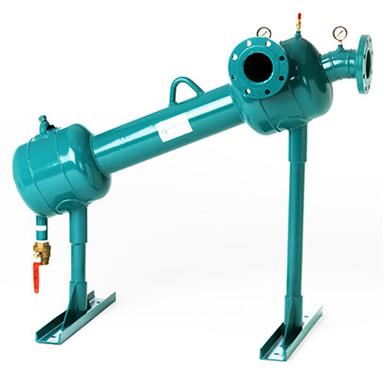
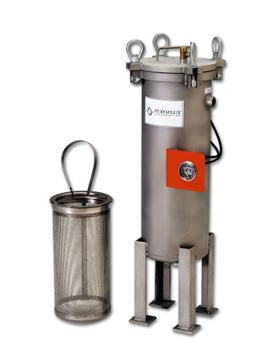
Overview
Puroflux’s complete line of separator and separator packages lend themselves to a wide range of applications for removing suspended particulate. Our standard equipment can handle flow ranges from 5 to 20,000 gpm and operating pressures up to 150 psi. Constructed from carbon steel, these rugged units can be installed in the harshest of environments. Custom separator systems can be designed and fabricated to meet specific requirements.
Description of Operation Hydrocyclone Separator
The basis for solid-liquid separation in the PF-60 series is the centrifugal forces created in the body of the separator. As the pressurized process carrying fluid1 enters tangentially into the entrance chamber of the separator, it starts a downward helical flow. This downward spiral motion causes high centrifugal forces to act on the carrying fluid. The solids in suspension are pushed to the wall of the separator and then move downward to the accumulation chamber (underflow)2 at the bottom of the separator. The clean process fluid then reverses its axial direction and moves upward in a helical flow exiting the separator (overflow)3.
There are many factors that can contribute to the success of the solid-liquid separator. It is important to understand and consider several issues when installing a hydrocyclone separator on a process system: system flow, velocity of the process fluid through the separator, pressure loss, specific gravity of the carrying fluid and particulate to be removed, and the purge cycle.
It is vital that the velocity of the carrying fluid be kept high in order to develop centrifugal forces in the body of the separator. Puroflux separators are designed with varying flow rates to insure that the separator selected will perform as expected.
Flow rate versus pressure loss are given for various PF-60 series separators to aid in selection (see individual specification sheets). The ideal operating pressure drop through a Puroflux separator is between 4-10 psi.
It is also important to note that the specific gravity of the solid to be separated from the carrying fluid must be higher than the specific gravity of the carrying fluid. The greater the specific gravity of the contaminate, the higher the removal efficiency of the separator. Puroflux separators can remove particulate as low as 45 micron (nominal) with a specific gravity greater than 1.2 on a recirculating basis.
Purging is necessary to eliminate the high concentration of solids build-up in the separator’s accumulation chamber and can be performed while the separator remains on-line. The level of contaminants in the process system will dictate the purge frequency and may warrant the use of an optional recovery system. If a recovery system is used, the separator will purge constantly at a low flow rate.